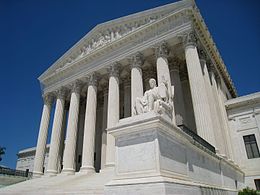
I first wrote about attacks on judges in 2011 and 2012. Newt Gingrich, the former Speaker of the U.S. House, even joined in on attacks on Judge Fred Biery in San Antonio. That was in 2011 and 2012. See those posts here. Those attacks have continued. Candidate and later Pres. Trump has now raised attacks on judges to an art form. Doing so is dangerous. There is a thin reed of civility that protects state and federal judges. Chief Justice Roberts has now issued his own warning against threats and intimidation toward the judiciary.

Chief Justice Roberts tells us that threats against judges have risen 100 fold in the last 10 years. Law enforcement officers around the country must now devote significant resources to protecting judges and investigating those threats – resources which would be better used to catch violent criminals. Too, accusing judges of political bias undermines their credibility, notes the Justice.

Politics

True, but during the Trump administration, all Federal judges were picked from the Federalist Society. Politics was injected into their nomination from the get-go. I suppose Justice Roberts prefers to avoid that elephant in the room.

The Chief Justice also notes the increasing public comments by politicians that judicial opinions should be ignored. The Justice’s comments are remarkable since he authored the decision that gave sitting Presidents virtually complete immunity for official acts. Pres. Trump will certainly feel emboldened to disregard which ever laws and edicts he disfavors.

Still, before 2011, threats against judges were relatively rare. The public discourse has changed dramatically. Making very public accusations of political bias used to be rare. See the ABA Bar Journal report for more information regarding Chief Justice Roberts’ warning.

The decision in Bostock v. Clayton County Georgia, 590 U.S. 644 (2020) was rendered in 2020. In that decision, the U.S. Supreme Court resolved a long-standing issue: does Title VII apply to homosexual based claims? Title VII of the Civil Rights Act of 1964 prohibits discrimination based on sex. Does “sex” include same sex? Yes, said the court in Bostock. I previously talked about that decision in Bostock here.

Texas Workforce Commission, Civil Rights Division rightly noted that that decision added “gender identity” to its list of claims which are protected under the state version of Title VII. TWC added “gender identity” to its online list of protected claims. Texas state law has always followed Federal law regarding discrimination. Since, the Texas version of Title VII is based on ….. Title VII.

But, Republican state Rep. Brian Harrison does not know this area of law. Heck, he is not even a lawyer. Rep. Harrison complained that TWC had adopted some new policy. Swiftly, Harrison’s complaint reached Gov. Abbott, who is a lawyer. Within days, the lawful listing of “gender identity” was removed. Harrison claimed a “victory” for Texans. Doubtless, TWC will still accept claims based on same sex discrimination. But, the “same sex” category has been removed from its website. Uninformed persons may believe they will not be protected and, therefore, not file a complaint with TWC.

Harrison may have won. But, his uninformed, uneducated complaint was a defeat for LGBT persons. The one Texas court of appeals to address the issue agreed that the decision in Bostock did indeed provid valid guidance for Texas courts. See Tarrant County College District v Sims, 621 S.W.3d 323 (Tex.App. Dallas 2021). TWC tried to follow the law. But, Rep. Harrison, with his economics degree, disagreed. See San Antonio Express-News report for more information.

Why do folks avoid jury duty? One reason is some, probably most people are just busy. Some people can multi-task. But, one juror learned the hard way that multi-tasking while sitting on a jury has consequences. Sallie Sue Smith was told she could not work on crossword puzzles while she should be listening and watching trial. Fine, she put the puzzle down. But, later during jury deliberations, she resumed working on her cross word puzzles.

The trial concerned a man who killed the mother of his child at Home Depot in Pensacola, Florida. The jury deliberations were acrimonious. There was shouting. Sallie said she can shout, too. Ms. Smith was in the minority of members. After five hours, the judge declared a mistrial, in part because one juror was working on crossword puzzles and presumably, not paying close attention.

But, Ms. Smith said she focuses better when she is doing her puzzles. See ABA Bar Journal report here.

I previously wrote about the potential effect of Project 2025 on the private sector workforce here. But, what about the Federal workforce? Well, looking at the book’s discussion of the Federal workforce, we enter the bizarro world of right-wing politics.

Right off the bat, the book claims that today, Federal workers are not held accountable. Project 2025, p. 71. For those of us who regularly represent Federal workers, this statement is farcical. If the workers are not held accountable, there would be no need for lawyers like myself. Even if we allow for some hyperbole on the part of the book’s authors, yes, Federal workers are held accountable. It is a myth that civil service workers cannot be fired. I see in the Federal workforce the same disciplinary measures I see among private sector employees.

Fully Successful

The authors are concerned that one study found that 99% of workers are rated fully successful or above. And, only 0.3% are rated minimally successful. The authors cite a 2013 report regarding permanent Federal employees. Project 2025, p. 73, n. 15. But, that conclusion says little, so far as it goes. That same study shows that three-fourths of GS-13 to GS-15 were rated in the top two categories. That is not a surprising result. There are just not many of those high level managers at the GS-13, GS-15 level – outside of Washington, D.C. In my 30 years of representing Federal employees far from the beltway, I have never represented anyone above GS-13. The ratings decrease some as you go down the GS rating ladder. See the study the authors used here.

This is just not a crazy result. In the military, we had a similar result that as you got higher, the performance ratings were higher. Yet, we did just fine weeding out the bad apples. In many private sector jobs, they do no performance evaluations. None. The Federal sector goes well beyond the private sector in both training of its managers and in employing a viable rating system. The Heritage Foundation is digging deep to find evidence of a lack of accountability.

Disparate Impact Lawsuits

Regarding Federal employees, the authors again attack disparate impact lawsuits – as their counter-parts did regarding private sector employees. Project 2025, p. 72, 583. Disparate impact lawsuits are exceedingly rare. Disparate impact lawsuits are lawsuits that claim a policy or rule has “impacted” large groups of protected people. Such as: a rule that would prohibit males from working as Flight Attendants. That is a rule that existed once and which was clearly based on gender. Those sorts of lawsuits are very rare even among the private sector workforce. Such lawsuits are even more rare among Federal employees. Since, unlike their private sector counter-parts, Federal workforce managers receive regular, frequent training on how to avoid managerial mistakes and possible acts of discrimination.

Careerists

The Project 2025 book gets into the bizarro world of politics when it warns against “careerists” who “lean heavily to the Left.” The book cites no source for this over-the-top claim. The authors then claim they need new job descriptions that avoid veteran preferences and other preference categories. Project 2025, p. 80. That is just an odd statement. Veterans actually hew to the political right if anything. Simply based on my personal experience in the military for 28 years and having lived in San Antonio, Texas, a Federal workforce dominated city, Federal workers come in all flavors. In the military, we worked with Federal workers wherever we had to reserve a firing range or a training area.

Veteran Preferences

Federal workers cannot be categorized one way or the other. I would like to see a serious study, but in my experience, most are conservative – simply because so many are veterans or are family members of veterans. Indeed, if you want to hire a new civil service employee at Ft. Cavazaos, Texas or Ft. Moore, Georgia, you would be hard pressed to hire someone who was not a veteran or related to a veteran. This is just a strange claim to make – and one for which the authors cite no authority or study.

And, of course, as a veteran, I agree with veteran preferences. Veterans make wonderful employees. And, for some vets, returning from war, job searching is a monumental task. They have earned some extra respect.

Federal judges are judges for life. Pauline Newman was appointed to the Federal Circuit Court of Appeals in 1984. The court hears patent claims and customs issues. In 2023, responding to complaints by staff that Judge Newman was being abusive, the judicial council for the Federal Circuit suspended Judge Newman, saying she had shown signs of cognitive decline.

The council placed Judge Newman on a one year suspension and started to investigate her abilities. It asked her to submit to a medical exam. She refused. Dr. Aaron Filler, an attorney who has appeared in front of Judge Newman, offered to conduct an exam of Judge Newman at no cost. Dr. Filler is also a neurosurgeon.

Dr. Filler found Judge Newman to be a “super ager.” She demonstrates a mental acuity of someone 20 years younger, said the doctor. Dr. Filler measured the blood flow to her brain and he interviewed her. Dr. Filler said her “rapid efficient responses” to difficult questions indicated a very high level of cognitive ability.” He discussed the reports of abusive behavior. He said most of those reports occurred subsequent to the initiation of the investigation and could have been due to stress.

The doctor concluded:

“She engages normally and fluidly in interaction and conversation without any apparent diminishment that might be associated with age in the 10th decade as to other individuals. In this regard she presents as a ‘super-ager’ in that she does not demonstrate effects of age on cognition or demeanor comparable to many others at this age.”

See ABA Bar Journal report here.

I wrote about Rudy Giuliani’s quixotic attempts to overturn the 2020 election results here and here. I mentioned not a few times how strange it was to see any lawyer, but especially a lawyer with Giuliani’s stature, risk his law license based on such flimsy cases. Yet, he did. And, now he has been disbarred by the Washington D.C. Bar Association. Typically, once a lawyer loses his license in one jurisdiction, other states will soon follow suit. It just boggles the mind how so many lawyers were willing to throw the dice with their law licenses for such little apparent gain.

The legal world is one of the few areas in which its major actor’s verbal assurance will generally be accepted at face value. A lawyer who makes some ambiguous claim in court will generally be accorded credibility. So, it makes sense that lawyers who abuse that privilege ought to lose that privilege. Rudy Giuliani ought to know that. See AP News report here for more information.

So, now Infowars will be auctioned off. Alex Jones opposed the move in a Houston bankruptcy court. But, theJudge found that was the way to best satisfy the judgments against the conspiracy theorist. See CBS news report here. I previously wrote about Alex Jones and the lawsuits against him here and here.

It’s a strange thing when a major personality will literally risk all he owns, just so he can spread harmful lies about innocent families.

There are several things an employer can ask in an interview. Let’s discuss a few.

1. How old are you? This is not a good question to ask. There are very few jobs in which age is a legitimate requirement for the job. Inevitably, this question will suggest age bias. It is best to not go there unless you are hiring for jobs with clearly appropriate age requirements, such as the U.S. Army.

2. Are you married? If you ask this only of female applicants, then this question could cause problems. Why would this question be helpful? Unless this is a ruse to discovery whether a female applicant might quit when she wants to have a baby. Its best to just not go there….

3. Are you a US citizen? It would be best to not ask this question until a job is offered. This question could conflict with the Immigration Reform and Control Act of 1986. It could also serve as evidence in an ethnic origin case, if the question is only asked about Hispanic or Hispanic-appearing applicants.

4. Do you have disabilities? Do not ask this specific question. But, an employer can ask if an applicant has any limitations that would keep him/her from performing essential functions of the job. How else would a fire deaprtment make sure an applicant can carry someone out of a burning building? So, yes you can ask about physical or mental limitations that would impair the performance of the essential functions of the job. But, do not ask about disabilities or diagnoses until a job offer has been made.

5.  Do you take drugs, smoke or drink? An employer can ask about drinking, smoking or illicit drug use. An employer should not ask about legal or prescription drug use, since that might involve issues of a possible disability.

6. What religion do you practice? An employer cannot ask about religious practices. Since, that could be used as evidence later of religious discrimination.

7. What is your race? No, of course, this would be an inappropriate question. See No. 6 above.  Don’t we all know not to ask this by now?

8. Are you pregnant? This question could be used as evidence of female stereotyping and, therefore, as evidence of gender bias. So, it is better not to ask this question. And, as the article mentions, refusing to hire a woman based on pregnancy or possible pregnancy would violate the Pregnancy Discrimination Act.

All of these warnings only matter if some adverse personnel action occurs later for which there is no otherwise reasonable explanation. If an employer asks about pregnancy and then later fires the applicant for some trivial error, only then would questions asked in an interview have any relevance. A discrimination lawsuit requires first and foremost a negative personnel action with no otherwise reasonable explanation. The lack of an otherwise rational explanation for an adverse personnel action is what makes prior discussions possibly relevant. The best defense for any employer is to simply issue written warnings whenever a transgression occurs. Emphasizing written discipline, applied consistently will serve the employer very well.

Those of us who practice within the boundaries of the Fifth Circuit (Texas, Louisiana and Mississippi) have known for some time that the Fifth Circuit has become the most aggressively conservative appellate court in the country. In fact, when the U.S. Supreme Court overturned Roe v. Wade in 2022, that was an appeal from a Fifth Circuit decision. That decision is now known as Dobbs v. Jackson Women’s Health Organization, 597 U.S. 215 (2022). In the coming Supreme Court term, the Supreme Court will hear five more appeals from the Fifth Circuit.

In the last term, the Supreme Court overturned the Fifth Circuit seven times. Six of the Circuit’s 17 judges are Trump appointees. Says Steve Vladeck, a former law professor at University of Texas and now at Georgetown Law, decisions by the 5th Circuit “have the effect of taking legal theories that were off the wall and putting them on the wall.” Or, as I said in one blog post, you know you’re conservative when you are even too conservative for the very conservative Supreme Court.

One observer, Akhil Reed Amar, a law professor at Yale Law School, noted that appellate court justices who want to get promoted to the Supreme Court will often do that by becoming more conservative, not less. That brings to mind one Judge Ho at the Fifth Circuit. In a remarkable turn of events, he actually wrote a concurring opinion to his own majority opinion. See ABA Bar Journal report for more information.

The Fifth Circuit Court of Appeals has been overruled a few times in the past few years. You know a court is too conservative when it is too conservative even for the very conservative U.S. Supreme Court. In the latest example, a group of five plaintiffs filed suit in the Western District of Louisiana objecting to the Biden’s administration unofficial pressuring of social media to deal with false content about the pandemic in 2021. The various platforms did indeed moderate their content, to make it more accurate. The five plaintiffs sued saying that that moderation infringed on their free speech rights.

In Murthy v. Missouri, No. 23-411 (June 26, 2024), the Supreme Court went beyond overturning the Fifth Circuit’s opinion. The opinion, written by Justice Barrett, also found the Fifth Circuit had glossed over the complexities of the case. That is judge-speak for the Fifth Circuit engaged in a fundamentally flawed analysis. The Fifth Circuit opinion, issued per curiam, was issued by a panel including Judges Clement, Elrod and Willett.

Standing

The higher court focused on standing. It found the five plaintiffs lacked standing. The plaintiffs included three individuals and two states. None of them, said the court, sought to enjoin the moderation used by the various platforms. Instead, the plaintiffs focused solely on actions taken by the Federal government.

The Fifth Circuit relied on factual findings by the district court. Some of those findings of fact were “clearly” erroneous. One of those erroneous findings was that the U.S. government and platforms had an “efficient report-and-censor relationship.”

Another error consisted of the Fifth Circuit treating the plaintiffs, the defendants and the platforms as a unified whole. But, precedent shows the court should have assessed standing for each claim against each defendant. That showing would entail showing that a particular defendant pressured a particular platform to censor a particular topic before that platform censored a particular plaintiff’s speech.

See the Supreme Court’s opinion here. See the ABA Bar Journal report on that opinion here.